Short summary
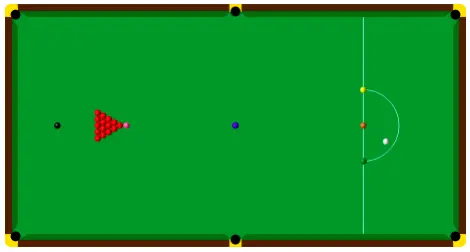
The balls are arranged on the table in a specific pattern before the start of the game. There is one white ball (the cue ball), fifteen red balls (each worth 1 point), and six balls of different colors, each with its own value, generally referred to as the colored balls. Each of these colored balls has a designated spot on the table.
The players strike the white ball and must always try to pot a red ball; if they succeed, they may then play a color of their choice. If that color is also potted, it is returned to the table and the player can play another red ball. If the color is not potted or if the player makes a mistake, the turn goes back to the opponent, who must start again with a red ball. Once all the red balls have been potted, the colored balls are potted in the order of their value, but they are not returned to the table anymore.
Game progression
The black ball is placed about 32 cm above the bottom cushion (top cushion) at the lowest spot. The blue spot is located exactly in the center of the table. The spot where the pink ball is placed is between the blue spot and the top cushion.
The fifteen red balls are arranged in a triangle against each other using a tool, and are placed as close as possible under the pink ball without touching it. In practice, the referee usually places the red balls first and puts the pink ball on its spot last.
At the top of the table, there is a cross line (baulk line) with a semicircle (the D) on it. From the bottom of the table, the yellow ball is placed on the left at the intersection of the line and the semicircle, the green ball on the right, and the brown ball in the middle.
The white ball (the cue ball) may be placed by the starting player at any position in the half circle. With this cue ball, the balls must be played in a specific order into the pockets. A player must first pot a red ball. If successful, they must then play a colored ball, which they must name before playing (the so-called 'calling'). In practice, this only happens when it is not immediately clear which ball they are going to play. If the colored ball is also potted, it is returned to its place (its own spot) and the player must play a red ball again. The red balls remain in the pockets and are not returned to the table, even if they have been potted incorrectly or jumped off the table. For each potted ball, the player receives the value of the ball (see below) on the scoreboard.
The number of points a player scores consecutively (without missing a ball) is called a break. When a break ends (by failing to pot a ball or making a foul), it is the opponent's turn, who must also start with a red ball. This continues until the last red ball is potted. The player may then choose a color to play for the last time. If they pot that ball, it is returned to the table and they may continue; if not, it is the opponent's turn. Now all the colored balls are played in order of their value.
The order is (value in parentheses) yellow (2) - green (3) - brown (4) - blue (5) - pink (6) - black (7).
The player who has the most points after potting the last ball has won the frame (a single game). The opponent can also concede earlier if the point difference has become too large and he finds it difficult to force his opponent into mistakes. A frame is concluded when either all the balls have been potted, or only the black ball remains on the table, the point difference is greater than seven points, and the player who is allowed to play at that moment chooses not to continue, or a foul is committed with only the black ball remaining on the table, or when the referee awards a frame to someone based on another rule.
A match consists of a predetermined number of frames. The match ends when one of the players manages to win the majority of the frames. When a match is played over 19 frames (best of 19), it means that the match ends when one of the players has won 10 frames. Major matches are often spread over multiple sessions of, for example, 8 frames.
Details
The ball that is played on (a red ball or a colored ball that has been called), is referred to as the object ball. The player must hit this object ball first with the cue ball; otherwise, penalty points are awarded. If the object ball cannot be hit directly, usually because another ball is in the way, it is referred to as a snooker.
It also occasionally happens that, when the cue ball is on the edge of a pocket, the edge of the cushion prevents the cue ball from hitting the ball-on in a straight line. In that case, it is said that the cue ball is angled.
Potting two or even more red balls in one turn is allowed - the player receives an extra point for each additional red ball.
When the spot of a colored ball is occupied, it is placed on the available spot with the highest value. If all spots are occupied, the ball must be placed as close as possible to its own spot, on the line in the center of the table, as close as possible to the top cushion. If different colored balls need to be returned, the ball with the highest value takes priority.
If a mistake is made while only the black ball is left on the table, the frame is over. The opponent receives seven penalty points, and the final score determines who wins the frame.
In the event of a tie at the end of a frame, to determine who wins the frame, the black ball is re-spotted, and the cue ball is placed anywhere of the player's choice in the D. A coin toss is used to decide who goes first; that player can choose to play themselves or let their opponent play. The first player to pot the black ball wins the frame. In the case of a foul (potting the cue ball or failing to hit the black), the opponent wins.
Fouls
- Playing the cue ball away (into a pocket or even off the table) or making it 'jump' over a ball, if that ball causes a snooker (is in the way). A played-away cue ball is placed by the opponent anywhere of their choice in the D. From there, they may play to any side of the table.
- No ball or hitting a wrong ball first
- Potting the wrong ball
- Touching a ball other than the cue ball, or touching the cue ball with something other than the tip of the cue
- The simultaneous contact of the tip, cue ball, and the ball-on. Therefore, 'pushing through' is not allowed when the cue ball and the ball-on are very close together. If they touch each other, it is called a touching ball, and the player must play away from the ball. In doing so, they are also not allowed to hit any ball, or a ball that is not on.
- Not touching the ground with at least one foot while executing a punch
- Playing while not all the balls are on the table (for example, if a colored ball has not been returned) or if not all the balls have come to a stop.
Fouls are penalized with penalty points; these are not deducted from the player's score but given to the opponent. The number of penalty points is always the value of the most valuable ball involved in the foul (the ball-on, a ball that was illegally pocketed or struck first, ...), but always at least 4 points.
Playing on a red ball but hitting nothing results in 4 penalty points; if the black ball is hit instead of another ball, this results in 7 penalty points.
If multiple mistakes are made in a turn, the mistake that results in the most penalty points counts.
In the event of a foul, any points already scored during a shot are also forfeited. For example, if a red ball is correctly pocketed but the cue ball also rolls in, the player receives no points, only penalty points. The points scored in earlier turns of the break do not, of course, get forfeited. If the player has already scored 10 points in their break and commits a foul on the next shot, they receive the 10 points, and their opponent receives the penalty points for the foul.
After the foul, the opponent's turn comes, but he can pass his turn to the player who committed the foul. In that case, he must play 'again,' but the balls are not returned to the positions they were in before the foul. In practice, this is only done if no good opportunity has arisen for the opponent after a foul. Any potential free ball (see below) is forfeited if the turn is passed.
Free ball
If the ball is positioned after a player's foul such that the term snooker applies (the ball-on cannot be hit directly from both sides because one or more other balls are in the way), a free ball is awarded. The opponent may then 'nominate' any other ball as the ball-on. This ball will then have the value of the ball-on, regardless of the value the ball normally has. If the nominated ball is a colored ball, it is returned to the table after being pocketed.
If the free ball is awarded for a red ball (if the player normally had to play on a red ball), then the player may play on a colored ball once he has pocketed the free ball, even when a colored ball was chosen as the free ball.